

The grand tour of Mustang with the TIJI festival (Tiji festival from May 19th to 21st)

All Inclusive Price

Trip Overview

Level 11/20 13 days of trekking at a maximum altitude of 4220m. Regular stages of 4 to 6 hours, except for the last three stages at the end of the trek (8 to 10 hours). No acclimatization issues.

This program takes you to the ancient forbidden kingdom of Lo, isolated in the heart of the Himalayas: a vast, arid plateau bordering Tibet, a mineral chaos with sulfurous colors, fairy chimneys, sculpted rocks, deep gorges, canyons with eroded cliffs, and small, secluded monasteries. This circuit offers a very comprehensive view of Mustang.

The mountains, eroded by infrequent rainfall, the ever-present wind, sun, and frost, form a landscape of rocky pillars and discontinuous moraines, which together present a palette of colors combining red, yellow, and brown. In this breathtakingly beautiful, wild, lunar landscape of otherworldly colors, eroded mountains soar towards the azure sky. Vast, desert-like hills stretch to the northern horizon, making us feel our insignificance in this timeless realm. Between the Tibetan Plateau to the north and the Annapurna massif to the south, this trek begins in Jomsom at the foot of majestic Nilgiri and leads you to Lo Manthang, the capital of this ancient, mythical, and mystical kingdom. This trek is not difficult, and the maximum altitude is only 4,220 meters.
Although the road connecting Jomsom to Lo is under construction, thousands of years of isolation have preserved the culture, lifestyle, and heritage unchanged to this day.

Highlights

  • A comprehensive exploration of the region and the Lo Mantang ramparts
  • The 3 days of the Tiji Festival
  • A very secluded region
  • A colorful mosaic of ochre, yellow, and brown

Itinerary

1 Arrival in Kathmandu.
After completing your visa and customs formalities, you will collect your luggage and be met at the airport exit by a representative from the agency. Transfer to the hotel. You will then collect your passports and pay the fees for the special Mustang permit to finalize the administrative procedures.
02 Flight to Pokhara.
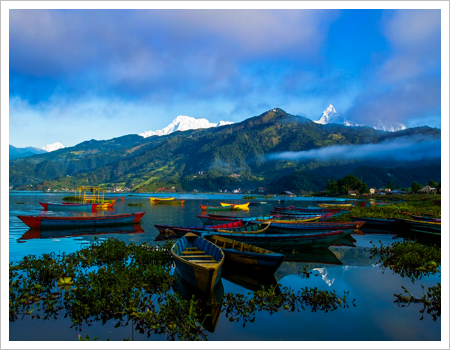
After a 30-minute flight along the Himalayan range, the aircraft lands in Pokhara, a city renowned for its Phewa Lake, in which the peaks of the Annapurna massif and the famous Machapuchare (meaning "fish tail" in Nepali) are reflected. The flight takes place in the early afternoon to allow time to obtain the special Mustang permits in the morning, using the required passports of all participants.
03 Flight to Jomsom 2740m
After an early wake-up call, we headed to the airport. Flights between Pokhara and Jomsom are only available in the morning due to the strong winds that pick up in Jomsom late in the morning. We enjoyed a stunning 25-minute flight between the Annapurna range on the right and Dhaulagiri on the left (where to sit on the plane?) over the Kali Gandaki River. We arrived in Jomsom, the district capital. Nilgiri Peak was within reach. We met the local team and assigned the loads to the mules before setting off on an unforgettable trek!
Jeep to Kagbeni (2880 m) and Chuksang (2950 m)
The construction of the road completely ruins the charm of the trek, so we travel by local jeep from Jomsom to Chuksang, stopping en route to visit Kagbeni and Thangbe, a village of rare beauty. It's an ancient fortress with its labyrinth of alleyways and its row of chortens overlooking the river. The path continues towards Chuksang, an ancient fortified settlement comprised of several hamlets and dotted with cave dwellings and monasteries.
04 Trek Chuksang – Samar (3450m) 4h lodge +660m – 30m
The path passes beneath a fort and a village with houses painted in colorful red and white stripes to the east. To the west, towering cliffs with eroded chimneys and ravines of yellow, gold, orange, and red dominate the landscape. After a short stretch along the river, the trail reaches the bridge at the foot of the Mustang Khola gorge, which winds its way through a tunnel beneath a vast block of red sandstone. From this bridge, the path climbs steeply to Chele, a village perched atop a rocky peak, a former control point for the valley. The route continues towards Samar along a steep path carved into the rock above a gorge, leading to a pass at 3,660 meters that offers a superb panorama of Nilgiri, Tilicho, Yakawa Kang, and Damodar Himal. The trail then enters a wide valley and descends to Samar, a beautiful village bordered by poplar trees.
05 Trek 4 Samar – Geling (3520m) 4/6h lodge + 750m – 820m
On the agenda for today are two possible routes: the main trail (4 hours) or the pilgrims' trail (6 hours). The latter, by far the more interesting, is steep and interspersed with steep climbs and sections along the clifftop, before beginning a long, steep descent into the heart of a magnificent gorge. A short detour leads to the Ranchung Cave: a sacred cave where nature has sculpted an immense chorten in the rock. The trail then ascends through a beautiful canyon to Shyangmochen and a small pass at 3800m, offering a first glimpse of the village of Geling below. From the pass, the path descends steadily into another, less steep ravine and then climbs again to emerge at a small cluster of houses. Ten minutes further on, you pass an old fort, from which there is a superb view of the picturesque village of Geling below, with its old royal palace and monastery.
06 Trek 5 Geling – Dhakmar (3800m) 6h lodge + 750m – 550m
The trail begins with the ascent of the Nyi La pass (3950m) in a semi-desert setting and descends gently to Ghemi, a pretty village nestled in lush greenery. Leaving Ghemi, we pass a long mani wall before climbing to Dhakmar, famous for its impressive red rock formations, which shelter numerous cave dwellings.
07 Trek 6 Dhakmar – Lo Gekar – Lo Mantang (3750m) 7h lodge + 900m – 830m
Ascent to the beautiful village of Marang and a detour to Lo Gekar Monastery, the oldest monastery in Mustang, dating back to the 11th century and housing large Buddha statues. Continue towards Lo Manthang across the vast high-altitude desert before crossing a final pass where prayer flags flutter. From the pass, you can see the Lo Valley and its fortified capital. The castle-city rises amidst mountains capped with eternal snow. Of the walls that enclose all the dwellings, only the white silhouette of the royal palace and the red masses of the three monasteries stand out. In the distance, the gray and red Namgyal Monastery sits on a rocky promontory, with the vast valley surrounding the villages of Tingkar and Phuwa behind it. The path descends and crosses a stream before climbing back up to Lo. Camp or lodge beneath the citadel walls.
08 to 10 A Lo Mantang lodge for the Tiji festival in a lodge
We dedicate these days to exploring this mystical and secluded city, enjoying the Tiji Buddhist festival and its dances. The monks' chants and the rhythmic sounds of horns accompanying prayers will awaken you from your sleep. Founded in 1380, the fortified city is surrounded by a wall that must be bypassed to the north to enter. The city is situated near the river. The surrounding fields are terraced, where rye is cultivated. Each field is enclosed by a low wall to protect the crops from animals. After breakfast, you will visit the four main monasteries; the major attraction being the three-tiered Jampa Lhakhang, the ochre-colored Thubchen Monastery with its vast hall, and the Chodey and Choprang Monasteries. We will lose ourselves in the labyrinth of alleyways, interacting with the ever-smiling locals (Lopas), tirelessly spinning their prayer wheels.
11 Trek Lo Mantang – Yara (3580m) 6h lodge + 680m – 800m
It is with regret that we leave the fortified city to retrace our steps to the pass overlooking Lo Manthang: a final glance back at the places we have visited in recent days, which we playfully reminisce about. From the pass, we follow a path traversing a lunar landscape that leads us to the heights of Dhi. A steep descent follows into an enormous, brightly colored canyon with its eroded cliffs and fairy chimneys. A bit of care is required to avoid slipping on the scree. We arrive in Dhi at 3400m and cross the river before climbing up to Yara, in the Puyon Chu gorge, in a still lunar and impressive setting of beige cliffs sculpted by repeated erosion.
12 Trek Yara – Lori Gompa – Yara 5h lodge + 400m – 400m
Today we hiked up to Lori Gompa, far from the usual trails. The path climbs to Gangra at 3870m and then traverses horizontally to the picturesque Lori Monastery, perched atop a cliff in a breathtaking setting. The temple is carved into the rock and houses unique paintings! We returned to Yara via a different route.
13 Yara – Tangye (3320m) 7h lodge + 900m – 1100m
Today we hike across a long plateau before descending steeply to cross a stream. Then, of course, the path climbs back up the other bank to a pass at 3860m. Next, we plunge through a series of fairy chimneys along a trail that demands careful attention due to loose stones underfoot. The path undulates before reaching another plateau. Before arriving in Tangye, the trail descends sharply. The village and its row of chortens are well worth a visit.
14 Tangye –Tetang (3000m) 9h lodge + 1300m – 1600m
Today's stage is the longest of the trek and begins with a descent before crossing the Tangye Khola River on a bridge and then climbing gently uphill over black, oozing salt soil. The path then descends again into the vast, rocky plain of the Yak Khola. After another river crossing and about an hour from Tangye, the trail climbs steeply on a sometimes narrow path. The views to the north are fantastic, with a panorama encompassing Tsarang, Lo, and the northern border. Finally, the pass summit is reached at 4,180 meters. To the south, Dhaulagiri dominates the landscape. Prayer flags flutter at the pass. Thirty minutes from the pass is the only water source for the day at Pa Ha. The trail continues its ascent, skirting prominent cliffs before reaching the head of the Narsing Khola valley. Vigilance is key, as the scenery is so breathtaking that it's tempting to venture too close to the edge of the ravines that plunge almost vertically 1,000 meters into the river! This section along the canyon rim showcases the most spectacular erosion of the entire trek. The trail then opens up, and to the south, you can see the impressive V-shaped valley of the Kali Gandaki River, which winds its way between Annapurna, Nilgiris, and Dhaulagiri. From this point, a spectacular descent begins through cones of soft volcanic rock. Eventually, the trail levels out and forks. We continue on to Tetang, a beautiful fortified village.
15 Tetang – Jhong (3700m) – Muktinath 3760m 6h + 1200m – 600m Jeep Jomsom.
After visiting Tetang, we ascend the valley floor, passing a few pastures amidst the rocks. The trail then crosses the Ghyu La pass at around 4100m, offering a superb view of the snow-capped Annapurna and Dhaulagiri massifs. The path descends towards Jhong and continues to the river of the same name, which we cross before climbing back up to Muktinath. We leave Upper Mustang. Muktinath is the stopover town after crossing the Thorong La pass when trekking the Annapurna Circuit. For us, it's also a true return to civilization, with vehicles and honking horns. We board a jeep to reach Jomsom, where we can enjoy peace and quiet and a more comfortable lodge.
16 Flight Jomsom- Pokhara – Kathmandu
An early morning flight to Pokhara, before the wind picks up. This 25-minute flight offers extraordinary views of the Annapurna and Dhaulagiri ranges. After a short stopover in Pokhara to change aircraft (the first one we used was operating the Pokhara-Jomsom shuttle before the wind grounded it), we fly along the Himalayan range and arrive in Kathmandu in 30 minutes, where our staff will be waiting to transfer us to the hotel.
17 Kathmandu Valley
Today we set off to explore the Kathmandu Valley, starting with the charming city of Bhaktapur, "the city of devotees," the jewel of the valley with its countless temples and scenes of rural life. After lunch, we return to Kathmandu, visiting the Hindu shrine of Pashupatinath, where all Hindus are cremated. Then we continue to the enormous Buddhist stupa of Bodhnath, where Tibetan pilgrims tirelessly circle the stupa, spinning prayer wheels and reciting their rosaries. What an atmosphere! Overnight at the hotel.
18 Departure from Kathmandu
Depending on flight times, it will be possible to do some last-minute shopping before heading to the airport for the return flight.

Gallery

You May Also Like --------

Similar Itineraries

8% Off

Ama Dablam Base Camp

US$ 1200/P

US$ 1100/P

22 reviews

The Arkhol Tshum Valley

22 reviews

From the Annapurnas to Everest

22 reviews

Ama Dablam Base Camp

22 reviews

Everest confort

22 reviews

Everest via the high passes (departure guaranteed on 17/10/2020)

22 reviews

Gokyo Valley – Renjo La

22 reviews

Everest Base Camp by Gokyo

22 reviews