
The Kanchenjunga

All Inclusive Price

Trip Overview

Level 15/20: This is a long trek, not for the average trekker, in an isolated region of the country with wild and untouched landscapes, where the inhabitants have seen very little change in their ancestral way of life. You will walk through pristine corners of this incredibly populated planet. This trek is a real physical challenge, with likely adverse weather conditions at altitude and the crossing of numerous high mountain passes. The stages are relatively long, leaving little time for rest in the evening. A very good level of physical fitness is therefore essential.

Kanchejunga, “the mountain of five treasures,” the third highest peak in the world, is located in the far east of Nepal and forms the border with neighboring Sikkim. The nearby Jannu (Kumbhakarna), at 7,710 meters, was first climbed on April 28, 1962, by a French expedition led by Lionel Terray. This long trek begins at the small Suketar airstrip, whose runway was completely renovated in 2011, and crosses traditional villages and terraced fields, magnificent forests, and reaches the southern base camp of the giant mountain. Crossing two passes, we then ascend the valley leading to Kanchenjunga’s northern base camp before descending to more typical altitudes in the Tamur Valley to return to Suketar. From there, we fly to Bhadrapur and then directly to Kathmandu. Wildlife enthusiasts will be in their element. This trek passes through numerous typical and picturesque villages and lush forests, as the monsoon is significantly stronger in eastern Nepal than elsewhere, and it always arrives from the east. This region is home to many ethnic groups: the Indo-Aryans are represented in the lower areas, as are the Newars, who have always been traders. The Limbu and Rai are the most numerous ethnic groups in this region. Higher up the mountain range you find the Sherpa ethnic group and people of Tibetan origin.

Highlights

  • Kanchenjunga [8586m], the third highest peak in the world
  • Impressive and majestic north face of Jannu
  • A region not frequently visited by trekkers
  • Rich cultural heritage and wild landscapes

Itinerary

01 Arrival in Kathmandu.
Upon exiting the airport, a representative from the agency will be waiting to assist you with a transfer to your hotel in a private vehicle. You will then receive an initial briefing on the trek's itinerary.
2/ Kathmandu – flight to Bhadrapur – Ilam
Flight to Bhadrapur, near the Indian border. Road transfer to Sukhetar. Stop in Ilam. Overnight in a lodge. (Breakfast, lunch, dinner.) 45-minute flight. 3-hour drive (105 km).
3/ Ilam – Sukehtar (2300 m) – Lali Kharka (2180 m)
End of the road journey to Sukhetar. Start of the trek. Upon arrival, we begin a short climb that leads us to a ridge. We then traverse a level path through a rhododendron forest. After crossing a river, we reach a small pass at 2520m before descending through the forest towards Lali Kharka. Overnight in tents. (Breakfast, lunch, dinner.) 160 km. 7 hours by road. 2.5 hours of walking. Elevation gain: 290 m. Elevation loss: 410 m.
4/ Lali Kharka – Kande Bhaniyang (2050 m)
Today's hike begins with a descent through terraced fields to the Gurung village of Thambewa (1800m), before crossing the river via a suspension bridge. A long climb then leads to the hamlet of Kunjar. The ascent becomes gentler, and we reach our first pass, from where Kangchenjunga is visible. Overnight in tents. (Breakfast, lunch, dinner.) 7 hours of walking. Elevation gain: 785m. Elevation loss: 915m.
5/ Kande Bhaniyang – Mamankhe (1770 m)
We descend to reach the Nandeva Khola river, which we cross (1500 m), before climbing back up to the village of Phun Phun, admirably situated on a ridge. A sometimes narrow path winds between the rice paddies overlooking the Kabeli Khola. After Anpan, the path climbs gently, then becomes steeper, to reach the hamlet of Phumphe. In the distance, we can see the summit of Jannu, called Kumbhakarna here. We descend in switchbacks to cross the Khaksewa Khola on a suspension bridge. The last climb of the day takes us to our camp in the village of Mamankhe. Overnight in tents. (Breakfast, lunch, dinner.) 8 hours of walking. Elevation gain: 725 m. Elevation loss: 1005 m.
6/ Mamankhe – Bhote Gaon (2080 m)
We have a rather difficult day ahead, constantly traversing the slopes and crossing numerous streams before reaching Yamphudin at 1690m, at the confluence of two rivers. We then head back up towards Bhote Gaon. Overnight in tents. (Breakfast, lunch, dinner.) 6 hours of walking. Elevation gain: 785m. Elevation loss: 475m.
7/ Bhote Gaon – Lamite Bhanjyang (3406 m) – Tortong (2865 m)
From Bhote Gaon, the trail is a rollercoaster ride for 1.5 hours, crossing the two tributaries of the Omje Khola. We continue through the forest to reach the Amil Khola riverbed, then a long climb towards the Lamite Bhanjyang pass. The path is lined with magnolias and then bamboo. At the pass, Mount Jannu seems very close. The descent on the opposite slope is too steep; we have to climb back up the ridge for another 150 meters before descending towards the Simbuwa Khola through a dense rhododendron forest. Between the branches, we can make out the bulk of Kangchenjunga. Another bridge leads to Tortong, on the banks of the Simbuwa Khola. Overnight in tents. (Breakfast, lunch, dinner.) 8 hours of walking. Elevation gain: 1750 m. Elevation loss: 965 m.
8/ Tortong – Tseram (3700 m)
A relatively easy day on the right bank of the Simbua Khola, fed by the Yalung Glacier, along a steady path through a dense forest of pines and rhododendrons. We stopped near a small shrine highly revered by the Sherpas. Emerging from the woods, we came into view of the terminal moraine of the Yalung Glacier, dominated by Kabru (7353 m) and Talung Peak (7349 m). Overnight in tents. (Breakfast, lunch, dinner.) 5 hours of walking. Elevation gain: 895 m. Elevation loss: 60 m.
9/ Tseram – South base camp of Kangchenjunga (Oktang, 4730 m) – Tseram
Round trip to Kangchenjunga's South Base Camp. A steep climb leads to the Yalung Bara alpine pasture, marking the upper treeline. We reach the ablation valley on the right bank of the Yalung Glacier. The going is steady, and we arrive at the Lapsang and then Ramche alpine pastures. We are at the foot of the gleaming peaks of South Kabru (7317 m), Rathong (6678 m), and Kokthan (6147 m). After a walk across the moraine, we reach Oktang (4730 m), from where the view of the south faces of Kangchenjunga and Jannu is breathtaking. Return to Tseram. Overnight in tents. (Breakfast, lunch, dinner.) 10 hours of walking. Elevation gain/loss: 1030 m.
10/ Tseram – Sinelapche La (4620 m) - Mirgin La (4580 m) - Selele (4130 m)
Today we change sides of the mountain range, skirting the entire massif to the west and heading towards its north face, crossing a high plateau. The climb is steep to reach the Sinelapche La pass (4640 m). A series of passes then leads us to the Mirgin La pass. Spectacular views of Jannu and, to the west, Makalu. Camp at the Selele alpine pastures. Overnight in tents. (Breakfast, lunch, dinner.) 8.5 hours of walking. Elevation gain: 1120 m. Elevation loss: 690 m.
11/ Selele – Sele La (4290 m) – Ghunsa (3450 m)
Today's stage is short, with a traverse leading us to the Sele La pass. The descent on the other side takes us to another pass: the Tamo La (3940 m), before plunging abruptly into a dense rhododendron forest towards the upper reaches of the Ghunsa Khola, fed by the Kangchenjunga glacier. The arrival among the larches at the "Tibetan" village of Ghunsa is magnificent. The afternoon is spent visiting the village and its gompa. Overnight in tents. (Breakfast, lunch, dinner.) 3.5 hours of walking. Elevation gain: 180 m. Elevation loss: 860 m.
12/ Ghunsa – Khambachen (4090 m) – north face of Jannu
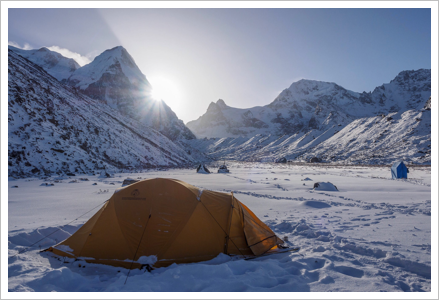
For two hours, we follow the left bank of the stream, an easy path through a beautiful larch forest. We cross the stream on a wooden bridge (3780 m). The trail then begins to climb. Around 4000 meters, we must traverse an exposed section (possible rockfall). Soon, Jannu reappears. We arrive at the village of Khambachen, inhabited only part of the year. Sunset over the vertiginous north face of Jannu (7710 m), the central pillar of the cosmological world of the Limbu people of eastern Nepal. Superb campsite. Overnight in tents. (Breakfast, lunch, dinner.) 6.5 hours of walking. Elevation gain: 825 m. Elevation loss: 185 m.
13/ Khambachen – Lhonak (4750 m)
An easy walk across meadows leads to the approach to the terminal moraine of the Kangchenjunga Glacier, marked by stone cairns erected by nomadic yak herders. We encounter large waterfalls, sometimes with snow bridges to cross. At Ramtang, a Tibetan alpine camp, we take a break. A short walk then takes us to the magnificent pastures of Lhonak, at the edge of a vast glacier. Overnight in tents. (Breakfast, lunch, dinner.) 7 hours of walking. Elevation gain: 725 m. Elevation loss: 65 m.
14/ Lhonak – North base camp of Kangchenjunga (5150 m) – Lhonak (4750 m)
An easy trail along the right bank of the Kangchenjunga Glacier. It takes approximately 3.5 hours to reach Pang Pema, the base camp for expeditions attempting to climb the world's third highest peak. Rounding the immense northern glacial cirque of Kangchenjunga, we enter the sacred realm of the gigantic northern wall, with its stepped glaciers. Return to Lhonak Camp in the afternoon. Overnight in tents. (Breakfast, lunch, dinner.) 6 hours of walking. Elevation gain/loss: 525 m.
15/ Lhonak – Ghunsa (3450 m)
We descend along the same path we took on the way up – but the atmosphere is completely different – ​​and arrive back at our campsite in Ghunsa. Overnight in tents. (Breakfast, lunch, dinner.) 8 hours of walking. Elevation gain: 250 m. Elevation loss: 1550 m.
16/ Ghunsa – Amjilessa (2400 m)
Crossing the Ghunsa Khola, then a forest trail towards the village of Phere, an important crossroads for yak caravans heading to the Nango La pass and Tibet. We then reach the village of Kyapra. After the terraced fields, the path enters a very steep gorge, at the bottom of which the river rushes as a raging torrent. We are perched high above the water for the rest of the trek. Overnight in tents. (Breakfast, lunch, dinner.) 8 hours of walking. Elevation gain: 635 m. Elevation loss: 1685 m.
17/ Amjilessa – Chirwa (1230 m)
We continue through the gorges all morning to Sekathum (1660 m), at the confluence of the Tamur, one of Nepal's major rivers. We cross the Ghunsa Khola, then, shortly after, the Simbua Khola. We camped on its banks on the evening of Day 8, much further upstream! A tough climb leads to the village of Hellok. A final view of Mount Jannu unfolds before us, before descending to the Tamur, which we cross at Tamewa, before reaching our camp amidst the cultivated terraces near the village of Chirwa. Overnight in tents. (Breakfast, lunch, dinner.) 9 hours of walking. Elevation gain: 340 m. Elevation loss: 1510 m.
18/ Chirwa – Mitlung (920 m) – Gandidanda
A lovely path winds through millet fields and vegetable gardens. A gradual return to civilization… We stop at the Gandidanda camp. Overnight in tents. (Breakfast, lunch, dinner.) 6 hours of walking. Elevation gain: 1300 m. Elevation loss: 710 m.
19/ Gandidanda – Sukehtar – Phiddim
The village of Sukethar is not far below; we reach it via a gently descending path. Bus to Phiddim. Overnight in a lodge. (Breakfast, lunch, dinner.) 3 hours of walking. 5 hours by bus.
20/ Phiddim – Bhadrapur, Vol Bhadrapur – Kathmandou
Transfer by bus to Bhadrapur, then return flight to Kathmandu in the afternoon. Evening at leisure, and overnight stay in a hotel. (Breakfast included.) 4-hour drive. 45-minute flight.
21/ Flight Kathmandu…
Transfer to the airport in the morning or afternoon.

Gallery

You May Also Like --------

Similar Itineraries

8% Off

Ama Dablam Base Camp

US$ 1200/P

US$ 1100/P

22 reviews

The Arkhol Tshum Valley

22 reviews

From the Annapurnas to Everest

22 reviews

Ama Dablam Base Camp

22 reviews

Everest confort

22 reviews

Everest via the high passes (departure guaranteed on 17/10/2020)

22 reviews

Gokyo Valley – Renjo La

22 reviews

Everest Base Camp by Gokyo

22 reviews