

THE TSUM VALLEY

All Inclusive Price

Trip Overview

Level: 12/20 20 days of trekking without any mountain passes to cross. Average stages of 5 to 7 hours. Hot and humid in the lower valleys, dry and cool in the Tsum Valley.

A trek not to be missed! The Tsum Valley was only opened to trekkers in 2008. There is no hotel infrastructure, no road, and no airstrip. It is accessible only on foot and is located in the far north of the Gorkha district, nestled in a setting of majestic mountains including Buddha Himal and Himal Chuli to the west, Ganesh Himal to the south, and Sringi Himal to the north. The word Tsum comes from the Tibetan word “Tsumbo” and means “living.”
The Tsum Valley is one of the eight sacred valleys, called Beyul, and owes its origin to the great Buddhist saint Padmasambhava in the 8th century. According to legend, Padmasambhava created these Beyuls to provide refuge for people fleeing the ravages of war, famine, and religious persecution.

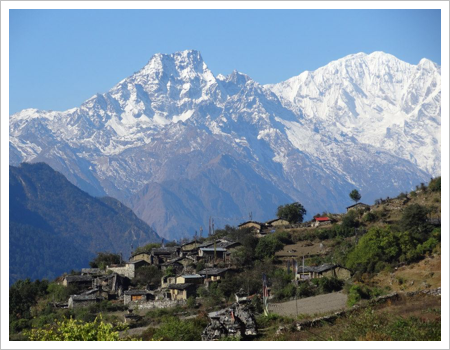
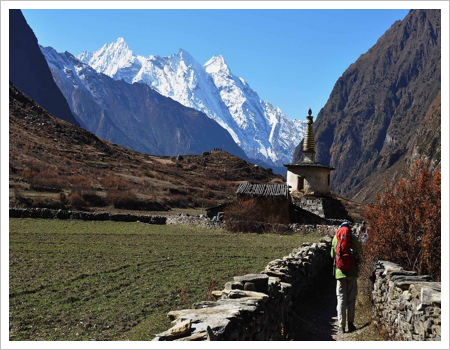
The valley is inhabited by the Tsumbas, a warm and welcoming people. As soon as you enter this valley, you immediately feel transported to another world. The valley is magnificent, with its cultivated fields, stone houses, clear, crystalline rivers, vast forests, and the surrounding mountains, some over 7,000 meters high.
Due to its remoteness and inaccessibility, this sacred valley and its inhabitants remained untouched by development for centuries. The result is a unique and pristine culture. The inhabitants have never killed an animal. A truly forgotten corner of the world!
Highlights

  • A valley open to trekkers only since 2008
  • Breathtaking views of Manaslu Buddha Himal/Himchuli Sringi Himal and Ganesh Himal
  • A truly unspoiled Tibetan culture
  • Off the beaten track
  • A striking contrast between the warm, humid subtropical valleys and the dry northern Tibetan villages

Itinerary

1 Arrival in Kathmandu.
After your visa and customs formalities, baggage claim and you will be met at the airport exit by a representative from the agency. Transfer to the hotel.
2. Transfer by bus to Gorkha (6 hours)
This is the start of an adventure. A very early departure by private bus takes us to Gorkha (1150m), the former capital of the Shah dynasty, located about 100 kilometers from the capital. Leaving the valley, we cross a small pass before plunging down a winding descent to the lower section, which then runs alongside the Trishuli River. During the season, it's not uncommon to see people rafting. Following the river, we arrive at Mugling, a small town whose appeal lies in its location at a crossroads: the road to India on the left and the road to western Nepal on the right. Continuing on, we reach Abukhaireni, where we turn right off the main road towards Gorkha. From Gorkha, we reach the Daraundi Khola River, which originates in the Rupina Glacier. The bus continues to Chepetar. Trek 1 > Baluwa (800m). 2h We leave the bus and cross via a suspension bridge and a track with local buses is passable in the dry season which takes us in 1 hour to Baluwa or in case of bad track we start our trek by going up along the river to Baluwa.
3 Trek Baluwa – Barpak (2,000m) +/- 6 hours of walking
We crossed the Daraundi River on a suspension bridge and began a long, seemingly endless climb up a steep, dry path—fortunately through the forest—to the village of Mandre. We finally reached the large, compact Gurung village of Barpak. There was a beautiful view to the south over the valley and hills, and to the north over Buddha Himal and its 6,672 meters.
4 Trek Barpak – Laprak (2300m) 4h
The path climbs to a pass at 2750m. From the summit of the Gupsi Pass, the trail descends through the forest to another impressive Gurung village, Laprak. Views of Budha Himal and Ganesh Himal.
5 Trek Laprak –Khorla Besi (970m) 6h30
The path descends steeply to cross the Machha Khola (meaning "fish river" in Nepali) on a suspension bridge. On the other side, the path climbs sharply at first, then levels out along the hillside with terraced fields cascading down the slope. Another long descent then leads to Khorla Besi, along the Budhi Gandaki River, which we will follow upstream in the following days.
6 Trek Khorla Besi – Jagat (1350m) 5h30
The trail continues along the right bank, following the Budhi Gandaki upstream, and in an hour we reach Tatopani (meaning "hot water" in Nepali). Many villages in Nepal bear this name due to their hot springs. A suspension bridge allows us to cross to the left bank and ascend to Dobhan, continuing along a pleasant plateau to Shiauli Bhoti. The path then climbs steeply towards Yaruphant, and we return to the right bank after crossing the Yaruphant Khola. The trail then reaches Jagat, the official entry point into the Manaslu area, where a checkpoint is located. We discover our first chorten.
7 Trek Jagat –Lokpa (2040m) 6h
We begin the day with the spectacular sight of two rivers (the Pangaur Khola and the Bhalu Khola) converging in a double waterfall just past the village. We continue uphill along the right bank before climbing the hillside, past terraced fields, to the village of Saguleri, from where we can admire Sringi Himal (7177m). The trail climbs steadily, passing alongside a mani wall at Sirdibas at 1420m, and continues to the bridge below Philim and the checkpoint. The path then becomes a balcony trail up to Ekle Bhatti at 1620m, offering a beautiful view of the village of Pansing opposite. Finally, the fork in the path arrives! The Tsum Valley has been a long time coming. The trail zigzags up through dense forest and opens onto terraced fields before reaching the small hamlet of Lokpa.
8 Trek Lokpa – Chumling (2360m) 3h30
From the hamlet, the path descends through dense forest towards the Tsum River and enters a narrow gorge. The trail clings to the rock face above the roaring river as it plunges down the gorge floor. The first snow-capped peaks appear through the foliage. Leaving the river, the trail climbs through forests of bamboo, blue pine, and rhododendrons. Passing through a simple gate, the lower Tsum Valley unfolds before us in a panoramic view. At Gumling, the trail forks, and each path continues uphill on either side of the valley. After crossing a bridge, the path ascends to the large village of Chumling, dominated by Kyong Peak. Visit to the Nyingma Monastery in the village.
9 Trek Chumling – Chokangparo (3010m) 8h
The path descends towards the Tsum River and past Tanjo Monastery. Continuing along the river, the trail reaches Dumji, then crosses the Syar Khola and climbs towards Gho for lunch. From Gho, it's a long ascent. The path is initially steep between chortens, then becomes more gradual, but always along the hillside and beneath the cliffs of Lapche Peak, with the high peaks of the Lombo Himal massif to the south. After an hour, we reach the Lapche sheepfolds at around 2920 meters and soon the entrance to the Upper Tsum Valley. We enter the Upper Tsum Valley through the village of Chokang Paro, a large village with a police station.
10 Trek Chokangparo – Chule – Nile (3360m) 4h 30
Leaving the camp, the path leads past the picturesque village of Dzong. The monastery, perched slightly on a rock, has been recently repainted. With terraced fields and a nearby pine forest offering views of the Ganesh Himal massif, it is truly a delightful spot. From Dzong, the path is level, and at Nakyu, we cross to the other side of the river, continuing along the right bank to visit the nuns of Rachen Gumba. Inside the monastery, we find beautiful statues and remarkably painted seats. We resume our walk on increasingly drier terrain, leaving the trees behind. Further on, we pass a cylindrical stupa with sparkling eyes and a golden pinnacle before reaching a gate marking the entrance to Chule and Nile. From this vantage point, we have a superb view of the valley below. We spend the afternoon exploring the monastery, which offers a magnificent panorama above the rooftops of Chule shimmering in the sunlight.
11 Trek Chule – Nile – Mu Gompa (3700m) 3h
Today's stage is short and mostly flat until Chumga before the trail climbs towards Mu Gumpa, the most remote and highest monastery in the valley. The surroundings are utterly austere. Steep slopes cut across even steeper slopes to infinity. Greyish torrents carrying scree meander hundreds of meters below between enormous cliffs. The clanging of bells announces the arrival of a yak caravan. We can choose to visit the nearby Dhephyudoma monastery with its nuns or climb even higher for a superb panorama at Dupchet.
12 Trek Mu Gompa – Rachen Gompa (3240m) 4 to 5 hours
On the way back down, we stopped for lunch in Phurbe before crossing the river to explore the two cave monasteries of Chi Phu and Milarepa Piren Phu on the other side of the valley near the village of Burji. The access to each cave is steep but well worth the effort. Chi Phu is smaller and features interesting paintings seen nowhere else. From the Milarepa cave, there's a commanding view of Rachen Monastery. It's the largest nunnery in the valley, and its interior houses beautiful statues and murals.
13 Trek Rachen Gompa – Dumje (2440m) 6h 30
We change banks and descend by the same path taken on the way there through the villages of Lamagaon, Nagchu, Chokang Paro to Dumji.
14 Trek Dumje – Gumba Lungdang (3200m) 5h
From Dumje, the Lungdang valley heads southwest to reach Lungdang Gumpa where we set up camp for two nights.
15 Trek Gumba Lungdang – Ganesh BC – Gumba Lungdang 6h
The forest disappears and is replaced by pastures, then by rocky moraines. The trail climbs rapidly to 4000m, passing chortens, before reaching the Ganesh Himal base camp at 4150m. The base camp is located at the foot of the west face of Ganesh I (7422m). The base camp forms a magnificent and vast cirque with Ganesh II, VI, IV, III, and I. Return to Lungdang via the same route.
16 Trek Gumba Lungdang – Ripchet (2400m) 5h
A superb morning descent took us past the Lungdang nuns and the Ganesh Himal cirque, before enjoying the afternoon views of the Shringi Himal massif, the highest peak north of Budhi Gandaki. It was a day spent entirely in the forest, and we reached the village of Dumje. At the end of the gorge, the trail crossed to the other side of the river to reach Ripchet. We enjoyed views of Shringi Himal from the camp.
17 Trek Ripchet – Philim (1400m) 6h
We leave the Tsum Valley and the Tsumbas with immense regret, departing from Lokpa. We will descend the Budhi Gandaki Valley. Camp at Philiù.
18 Trek Philim – khoralabesi (970m) 6h
The trail follows the river to Jagat before descending to the small village on the banks of the Yaru. The vegetation changes completely, becoming subtropical with banana trees and sugarcane. The Dhoban plateau is ideal for a picnic. Terraced fields become more numerous near Tatopani. Another hour to reach Khorlabesi camp.
19 Trek Khoralabesi – Soti Khola (710m) 6h
The trail continues alongside the river before crossing it at Macha Khola. As the altitude decreases, the temperatures rise… The path passes through numerous villages with intensive terraced farming. We trek through beautiful tropical bamboo forests. Camp at Seti Khola.
20 Trek Soti Khola – Arughat (500m) 3h Bus Drive to Kathmandu
This is our last day of hiking, still along the Budhi Gandaki River, amidst terraced fields. If the track isn't passable for jeeps, we'll take them to the Arughat bazaar. From there, we'll take a bus back to Kathmandu. Back to civilization, to chaotic road traffic, to the cacophony of horns. The climb to the pass before entering the Kathmandu Valley is impressive, all switchbacks and heavy truck traffic from India. What a joy to have a good shower and a comfortable bed tonight!
21 Airport transfer for the return flight.
Free morning for last-minute shopping and a final stroll through old Kathmandu before heading to the airport.

Gallery

You May Also Like --------

Similar Itineraries

8% Off

Ama Dablam Base Camp

US$ 1200/P

US$ 1100/P

22 reviews

The Arkhol Tshum Valley

22 reviews

From the Annapurnas to Everest

22 reviews

Ama Dablam Base Camp

22 reviews

Everest confort

22 reviews

Everest via the high passes (departure guaranteed on 17/10/2020)

22 reviews

Gokyo Valley – Renjo La

22 reviews

Everest Base Camp by Gokyo

22 reviews